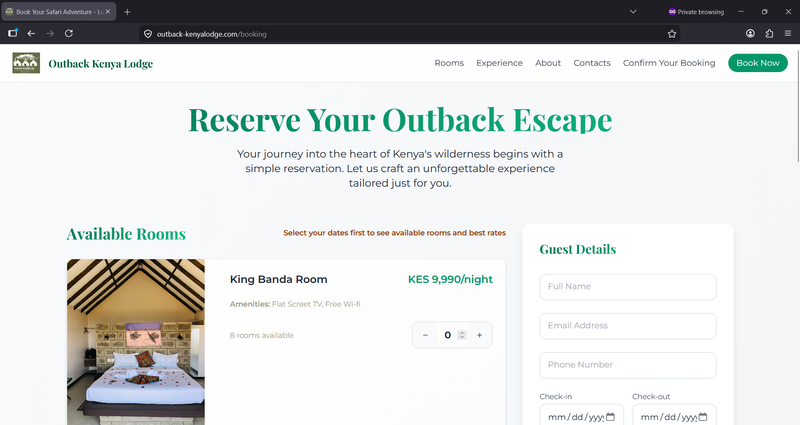
Outback Kenya Lodge has been welcoming guests to Maanzoni Game Ranch since 1985. What started as four traditional bandas, built on one family's vision to share the beauty of the Kenyan savannah, has grown over three generations into a full lodge with rooms, conference facilities, and event spaces, all about 30 minutes from JKIA.
In early 2025, we worked with the lodge to bring their booking and reservations process online, from the moment a guest first looks at a room to the moment staff confirm a stay. This article walks through what that involved. Not the code, not the architecture, but the actual thinking behind each decision, because we think it's a useful read for any business in hospitality, events, healthcare, or anywhere else where customers need to check availability and pay before they show up.
Whenever we take on a booking system, before touching anything else, we ask one question: what does someone actually need to see, in what order, to comfortably make a decision and pay?
It sounds almost too simple to matter, but most booking systems that frustrate guests fail right here. They show a room without confirming it's actually free for those dates. They show a price that turns out not to be the final price. They make payment a separate, clunky step that happens somewhere else, on a different screen, sometimes a different website entirely, leaving the guest unsure whether their booking actually went through.
For Outback Kenya Lodge, we treated availability, pricing, and payment as one connected experience rather than three separate problems bolted together. A guest looking at the King Banda Room for a specific weekend needed to see, instantly, whether that room was genuinely free for those dates, what it would actually cost once any seasonal pricing applied, and a way to pay immediately, without leaving the page or waiting for someone to call them back.
This matters more than it might seem. Every extra step between "I want this room" and "I've paid for this room" is a chance for a guest to lose momentum, get distracted, or simply give up and look elsewhere. The goal of the whole booking flow was to remove every unnecessary step between those two points.
A common mistake when building any booking system is treating price as one fixed number per room. In reality, almost no hospitality business actually prices things that simply.
A night during a quiet week looks different from a night over a public holiday. A long weekend might carry a different rate than a single midweek night. A lodge might want to run a short promotional discount during a slow season, or offer a special rate to past guests, without that discount applying indefinitely or to every room.
If you try to handle this manually, someone on staff needs to remember which dates have which pricing, update it consistently, and hope nobody forgets to revert a discount once it ends. That's a recipe for either lost revenue (forgetting to raise prices during a busy period) or upset guests (a discount that was supposed to end last week somehow still being honoured, or worse, the opposite).
So instead of one price per room, we built a pricing engine that calculates the correct rate for every individual night of a stay, automatically layering in seasonal adjustments and any active promotions on top of the base rate. If a guest books three nights that happen to span a public holiday, the system calculates each night's price individually, accounting for whatever rules are in effect for that specific date, and presents one accurate total. Nobody on the lodge's side has to remember anything or manually recalculate a thing.
The benefit of this approach is that pricing decisions become something the lodge can plan in advance, once, rather than something someone has to actively manage every single day. Set the rules for the season, and the system applies them consistently from that point forward, for every booking, automatically.
It's easy to think of a booking system as just the public-facing website, the part guests interact with. In our experience, the dashboard staff use behind the scenes often matters just as much, sometimes more, because it's where the business actually runs day to day.
Before this project, reservations for a business like this typically live in a mix of places: someone's memory, a notebook, a spreadsheet, scattered messages across different channels. None of those give you one clear picture of what's actually happening across all your rooms on any given date.
We built a private dashboard where staff can see every booking, every room, and every date in one place. A calendar view shows, at a glance, what's booked, what's pending payment, and what's deliberately blocked off, whether that's for maintenance, renovation, or any other reason the lodge needs to take a room temporarily out of circulation. There's no need to cross-reference multiple sources or rely on someone's memory of who's arriving when.
When the lodge wants to run a promotion, say, a discounted rate for long weekends during a particular month, they set that up once inside the dashboard. From that point forward, the system applies the discount automatically to anyone booking those dates, and it notifies people who've booked with the lodge before, without anyone needing to manually compile a list or send anything by hand.
We think this is the part of a project that tends to get the least attention publicly, simply because guests never see it, but it's usually where the most time gets saved. A booking system is only as useful as the tools it gives the people actually running the business.
For a business based in Kenya, this almost always means M-PESA needs to work properly, smoothly, and reliably, alongside card payments for guests who prefer that option, including international visitors arriving from outside the country.
We integrated Pesapal, a payment gateway widely used across Kenya, to handle both M-PESA and card payments in one place. This meant a guest could complete their booking and pay for it in one sitting, on one screen, without being redirected somewhere unfamiliar, asked to complete a separate transaction and report back, or left wondering whether their money actually went through.
The moment a payment is confirmed, a confirmation email goes out automatically to the guest. Nobody on the lodge's side needs to manually check whether a payment landed before confirming a guest's stay. The system already knows, and it acts on that information immediately.
This kind of immediate, automatic confirmation matters more than it might initially seem. A guest who pays and then has to wait, uncertain whether their booking is actually secured, is a guest who's more likely to call, message, or worry, all of which creates work for the lodge that simply doesn't need to exist.
Building the booking system itself was only part of this project. Alongside it, we also moved the lodge's hosting and email infrastructure to more reliable providers.
This is a detail that's easy to overlook from the outside, but it matters enormously in practice. A booking system that's occasionally slow to load, or confirmation emails that occasionally don't arrive, quietly undermine all the careful work that went into the booking flow itself. From a guest's perspective, there's no meaningful difference between "the booking system has a bug" and "the booking system is slow because the server it's hosted on isn't reliable." Either way, their experience suffers, and they don't particularly care which part of the technical chain is responsible.
We treat hosting and infrastructure as part of the actual product we deliver, not a separate concern. Since this project wrapped, we've continued hosting and maintaining the system, watching for issues, keeping things updated, and making sure the lodge doesn't need to think about any of it. We think this is something worth doing for any client launching software that guests will rely on regularly, because software that handles real money and real reservations needs someone paying attention to it on an ongoing basis, not just someone who built it once and moved on.
Outback Kenya Lodge's situation isn't unique, and that's part of why we think it's worth writing about. Plenty of established, well-run businesses across Kenya, hotels, lodges, event venues, clinics, schools, gyms, are genuinely excellent at what they do, with decades of reputation and loyal customers, but still rely on phone calls, messages, and manual processes simply because nobody has ever built them anything better suited to how they actually operate.
The technology required to fix this isn't exotic or experimental. Real-time availability, automatic pricing, and integrated payments are all things that can be built reliably with the right approach. What actually matters, and what tends to separate a good system from a frustrating one, is understanding the specific business well enough to build something that genuinely fits how they work, rather than forcing a generic template onto them and hoping it's close enough.
A lodge has different needs from a clinic. A clinic has different needs from an event venue. The underlying building blocks, availability, pricing, payment, automated notifications, often look similar from a distance, but the details of how they need to fit together are different every time. That's the part of this work we find genuinely enjoyable: taking the time to understand a business properly before building anything for it.
If you're running a business where customers need to check availability, get an accurate price, and pay before showing up, whether that's a lodge, a clinic, a venue, or something else entirely, this is the kind of system worth having. Feel free to reach out if you'd like to talk through what that could look like for your business.
Outback Kenya Lodge's booking system is live at outback-kenyalodge.com. We design, build, and maintain custom software for businesses across Kenya. Get in touch to talk about your project.
No comments yet
Be the first to share your thoughts on this article!