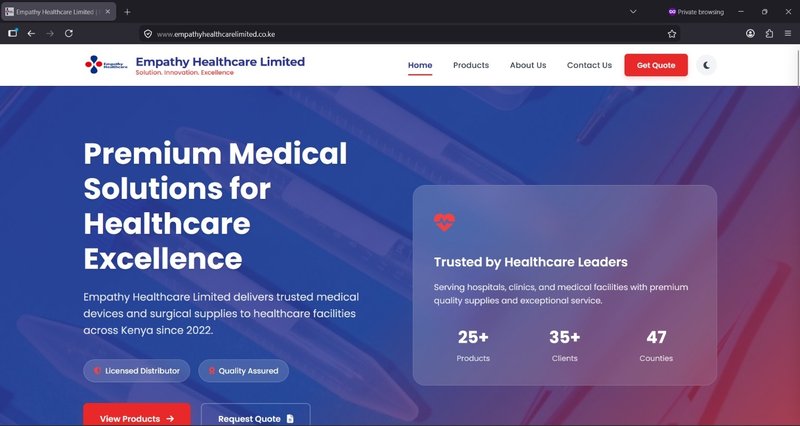
Empathy Healthcare Limited is a certified medical devices and surgical supplies distributor, supplying hospitals, clinics, mission hospitals, and training institutions across all 47 counties in Kenya. Their catalogue spans surgical kits and drapes, gastroenterology products, interventional devices, and nutritional and enteral feeding supplies, the kind of products a hospital genuinely cannot afford to be uncertain about when placing an order.
In late 2025, we built Empathy Healthcare a brand new website, from the ground up, on entirely new technology, replacing their previous site completely. From our first conversation about what they needed to a fully hosted, live website, the whole project took three weeks. We want to walk through what that involved, because we think the pace and the approach are both worth explaining, not just the result.
When a business comes to us with an existing website that isn't working well enough, there's always a decision to make: do you repair what's there, or do you start again. For Empathy Healthcare, we chose to rebuild entirely on new technology rather than attempt to patch the previous site.
This isn't a decision we make lightly, since a rebuild takes more upfront work than a series of small fixes. But for a distributor whose buyers are hospitals and procurement officers, people who need to trust what they're looking at, a site that feels dated, loads slowly, or behaves inconsistently quietly undermines confidence before a single conversation even happens. We felt the right move was to give Empathy something built properly from scratch, rather than something patched together on top of an older foundation.
Designing Around How a Hospital Actually Buys
A medical supplies distributor isn't selling to casual browsers. The people visiting Empathy's site are procurement officers at national hospitals, administrators at county facilities, buyers at mission hospitals, and directors at private clinics and training institutions, people who need specific products, often urgently, and who need a straightforward way to ask for pricing without unnecessary friction.
So before writing a line of code, we thought carefully about what that visit actually needs to accomplish. A buyer needs to see the breadth of what's available, organised in a way that makes sense to someone in healthcare procurement, not in a way that makes sense to a software developer. They need to find the right category quickly, whether that's surgical kits, gastroenterology products, infection control supplies, or specialised devices, and then move straight into requesting a quote without having to dig for a contact form buried somewhere in a menu.
We built the site around that journey: a clear breakdown of product categories on the homepage, a full catalogue page where buyers can browse in depth, and a dedicated quote request page that's easy to find from almost anywhere on the site. The goal throughout was to make the distance between "I need this product" and "I've requested a price" as short as possible.
This is the part of the project we think matters most, even though it's invisible to a casual visitor.
The moment a buyer submits a quote request, two things happen immediately. First, the buyer receives a written confirmation by email, telling them their request has been received and that they can expect a response within 24 hours. They're not left wondering whether the form actually worked. Second, Empathy's own team receives the inquiry instantly, already structured: who's asking, what organisation they represent, what they need, and how to reach them. No piecing together fragments of a phone call from memory, no incomplete details that need a follow-up call just to clarify what was actually being asked for.
This matters for a business fielding inquiries from hospitals across the country. Every inquiry that arrives complete and well-organised is one the sales team can act on immediately, rather than one that needs a round of clarifying questions before any real work can begin.
A public quote request form attached to a real company's contact details is, unfortunately, a target. Automated bots regularly find and flood public forms with spam, fake inquiries, irrelevant links, nonsense submissions, the kind of noise that can bury genuine business inquiries if left unchecked.
We built in protection against this from the very beginning, rather than treating it as something to fix later. The form includes several overlapping layers of protection: automated bot detection, limits on how many submissions can come from one source in a short period, and a hidden field that only an automated script would ever fill in, which immediately flags the submission as fake. Combined, these mean the inquiries landing in Empathy's inbox are real hospitals and real clinics, not noise that has to be manually filtered out every morning.
We also made sure that submitting the form feels instant from the visitor's side. The confirmation email is sent in the background, so a buyer submitting a request sees their confirmation message right away, without sitting and waiting for an email to process before the page responds.
Alongside rebuilding the website, we also migrated Empathy Healthcare's email to Zoho Mail. This is worth explaining, because it's easy to assume email is email, and it isn't quite that simple, especially for a business whose email needs to reliably deliver instant quote confirmations and internal alerts the moment a form is submitted.
Zoho Mail is a business email platform that gives a company proper, professional addresses on their own domain, info@empathyhealthcarelimited.co.ke, for instance, rather than relying on a free consumer email service, while also offering strong deliverability, meaning emails sent from it are less likely to be marked as spam or simply fail to arrive. For a business like Empathy, where a missed or delayed confirmation email could mean a hospital buyer assumes their request went nowhere and looks elsewhere, reliable email delivery isn't a small detail. It's part of the same trust-building work as the website itself.
Migrating email isn't just flipping a switch, either. It involves moving existing mailboxes and their contents, updating domain settings so mail correctly routes to the new provider, configuring the records that tell other mail servers your email is legitimate and not spam, and making sure nothing gets lost or interrupted in the process, particularly while a business is actively receiving inquiries from hospitals that can't afford to fall through the cracks during a transition. We handled this migration as part of the same project, alongside the website rebuild, so Empathy's email and website went live working together from day one, rather than as two separate efforts stitched together afterward.
We also moved Empathy Healthcare's hosting to AWS, Amazon's cloud infrastructure platform, which is widely used precisely because of how reliable and scalable it is. For a distributor whose website needs to be available whenever a hospital procurement officer decides to visit, whether that's during business hours or late at night while preparing paperwork for the next morning, hosting reliability isn't a background technical detail. It's part of whether the business is actually reachable when a buyer needs it to be.
We've continued managing both the hosting and the email since the project went live, watching for issues, keeping things updated, and making sure Empathy doesn't need to think about any of it day to day.
We want to be specific about the timeline, because we think it matters and we don't want to overstate it. From our first conversation with Empathy Healthcare about what they needed, through understanding their business and their buyers, designing the new site, building it, migrating their email, setting up hosting on AWS, and going fully live, the entire project took three weeks.
We don't think speed alone is impressive. What we're proud of is delivering that speed without cutting corners on the parts that actually matter: a site that's genuinely built around how hospital buyers work, a quote system with real spam protection, reliable email, and infrastructure that doesn't need babysitting. Three weeks is fast because we had a clear process, not because we rushed past anything important.
Empathy Healthcare already has a strong reputation, serving hospitals, clinics, and training institutions across the country with products trusted by people who genuinely cannot afford unreliable suppliers. Our job wasn't to build them credibility. It was to make sure their website matched the credibility they'd already earned, and made it as easy as possible for the next hospital buyer to find what they need and get a quote without friction.
That's the kind of project we enjoy most: a business that's already doing real, important work, given the digital front door that actually reflects it.
Empathy Healthcare Limited's website is live at empathyhealthcarelimited.co.ke. We design, build, host, and maintain custom websites and software for businesses across Kenya. Get in touch to talk about your project.
No comments yet
Be the first to share your thoughts on this article!